
A great meal often begins with a single slice, and the tool in your hand makes all the difference. If you’ve ever felt unsure or tense while chopping, you’re not alone. A sharp knife is essential for efficient cooking, yet it’s also behind many common kitchen injuries when handled without confidence. The good news? Safety isn’t about hesitation — it’s about control. In this guide, you’ll learn foundational techniques that professional chefs rely on to stay precise and protected. These practical, actionable tips — especially helpful for knife skills for beginners — will immediately improve your confidence, reduce risk, and transform the way you prep.
The Foundation: A Secure Grip and a Stable Surface
Before you dice a single onion, you need a foundation. Great cutting isn’t about speed—it’s about control. And that starts with how you hold the knife and stabilize your space.
The Pinch Grip
First, master the pinch grip. Instead of gripping only the handle, pinch the base of the blade with your thumb and index finger, then wrap your remaining fingers around the handle. This shifts control closer to the knife’s center of balance (typically where blade meets handle), giving you greater stability and cleaner, straighter cuts.
In contrast, holding just the handle reduces precision and can cause the blade to wobble. With the pinch grip, your knife feels like an extension of your hand—not a loose tool you’re steering from a distance (think surgeon, not lumberjack).
The Guide Hand (“The Claw”)
Next, your non-knife hand plays defense. Form a claw by tucking your fingertips under and letting your knuckles face outward. The flat side of the blade rests lightly against your knuckles as you slice.
Benefits of the claw grip:
- Protects fingertips from accidental cuts
- Creates consistent slice thickness
- Improves rhythm and confidence
This technique is foundational in knife skills for beginners because it makes fingertip cuts virtually impossible when done correctly.
Secure Your Cutting Board
Finally, anchor your cutting board. Place a damp paper towel or non-slip mat underneath it. A sliding board is a major hazard—and no technique can compensate for instability. A steady base isn’t optional; it’s non-negotiable.
Mastering the Motion: Safe and Efficient Cutting Techniques
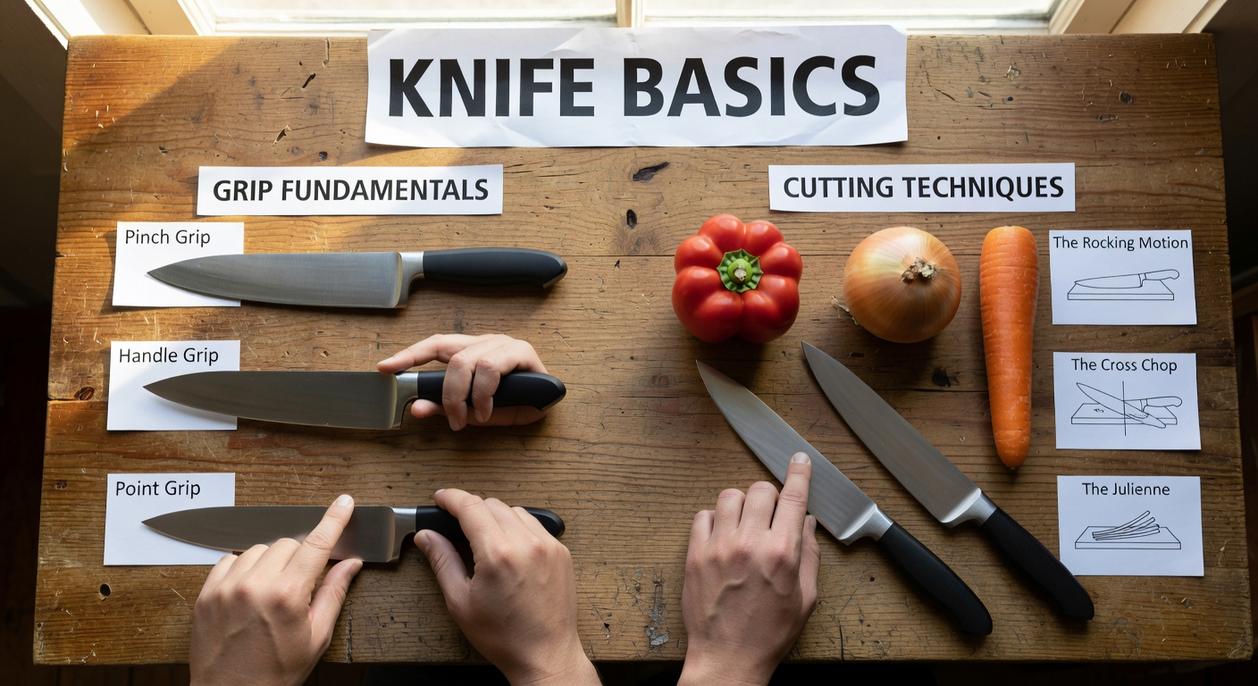
Great cooking starts before the pan even heats up. It starts with how you handle your knife. If you’re working on knife skills for beginners, these recommendations will immediately make you safer and more efficient.
Create a Flat Surface
Round vegetables roll. Rolling vegetables cause slips. Slips cause stitches (and nobody wants that). Always slice a thin piece off potatoes, onions, or carrots to create a stable base. That flat side anchors the food to the board, giving you control from the very first cut. It may feel like “wasting” a small piece, but the stability you gain is worth far more.
Use the Rocking Chop
Your chef’s knife is designed for a rocking motion—meaning the tip stays in contact with the cutting board while you lift and lower the heel. This creates a smooth arc rather than a straight up-and-down chop. It’s faster, more controlled, and less tiring. Think of it like a metronome in motion—steady, rhythmic, efficient.
Never Force a Cut
A sharp knife should glide through food with minimal pressure. If you’re pushing hard, your blade is dull. And a dull knife is actually more dangerous because it can slip off the surface instead of biting in (counterintuitive, but true). According to culinary safety research from the National Safety Council, dull blades contribute significantly to kitchen injuries.
Cut Away From Your Body
When peeling or trimming with a paring knife, direct the blade away from your hands and torso. It sounds obvious—until you’re rushing. Slow down. Control beats speed every time.
A Sharp Knife is a Safe Knife: The Importance of Maintenance
First, let’s debunk a stubborn kitchen myth. A dull knife is not safer—it’s riskier. When a blade is blunt, it slides across an onion’s slick surface instead of biting in. You push harder. The carrot resists. Suddenly, the knife slips sideways (and your heart jumps with it). A sharp knife, by contrast, grips the food immediately, sinking in with a clean, quiet slice. Less force means more control, which is the foundation of knife skills for beginners.
However, sharp doesn’t stay sharp on its own. That’s where honing and sharpening come in. Honing—using a steel—realigns the microscopic edge of the blade. Think of it as combing tangled hair back into place. It should be done frequently. Sharpening, on the other hand, removes metal to create a brand-new edge. Because it reshapes the blade, it’s needed less often.
Equally important is how you clean your knife. Wash it by hand, one at a time, blade facing away. Never leave it lurking in cloudy, soapy water (that’s a cut waiting to happen). Dry it immediately and thoroughly to prevent rust. For more cooking technique insights, see sauteing vs stir frying whats the real difference.
Beyond the Cut: Proper Handling and Storage
The Golden Rule: A falling knife has no handle. Never try to catch a falling blade. Step back, let it hit the floor, and save your fingers for dinner prep (dramatic ER stories are overrated).
Tossing knives loose in a drawer is basically a booby trap for your future self. Instead, store them in a knife block, on a magnetic wall strip, or inside in-drawer sheaths or guards. Your hands will thank you, and so will anyone learning knife skills for beginners.
When passing a knife, don’t play hot potato. Place it flat on a surface and let the other person pick it up. Simple, calm, and far less scream-inducing. Safety first, stitches never. Your kitchen will agree.
Making Safety Your Sharpest Skill
You came here to feel more confident with a knife in your hand—and now you have the core principles to do exactly that. That hesitation around sharp blades is normal, but it doesn’t have to control your cooking. By applying the right grip, refining your technique, and maintaining your knives properly, safety becomes automatic. Start today with the “claw” grip and always create a flat surface on your vegetables. These two habits alone will transform your knife skills for beginners. Don’t let uncertainty slow you down—practice now and turn safety into your greatest strength in the kitchen.